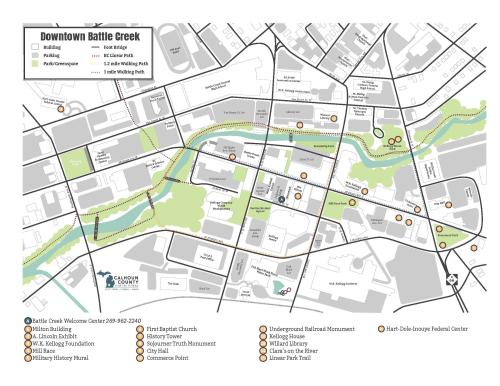
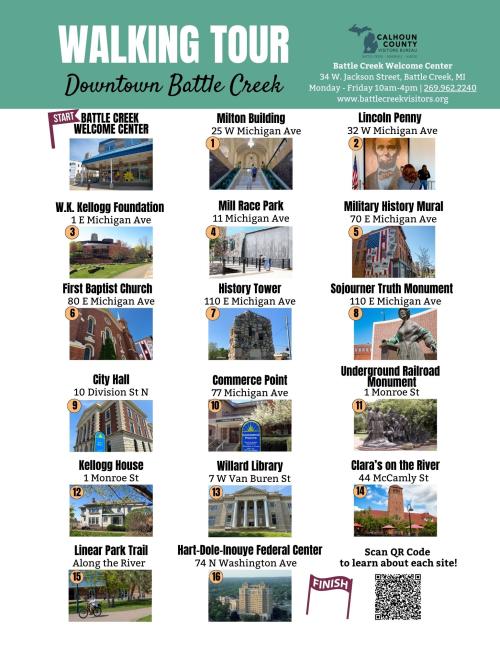
Downtown Battle Creek Walking Tour
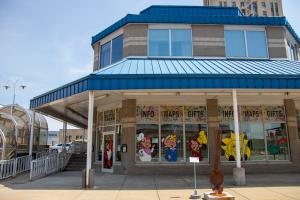 START: Battle Creek Welcome Center
1. Milton Building
This art deco gem was built at the same time as the Battle Creek Transamerica Tower. Both competed to become the tallest building in Battle Creek. The Milton won by adding two more stories than originally planned, totaling up to 20. It 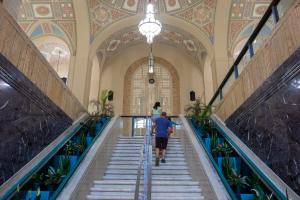 was first called the Old Merchants Tower, since it was built for the Old Merchants National Bank and Trust Co.
An escalator, installed by the Otis Elevator Company, was rare enough that it was a big attraction in the area. People would visit just to ride the escalator.
Nowadays, you can walk inside and up the lobby stairs to see the extravagant art deco murals in shades of blue and gold on the ceiling. The escalator is no longer there, but the fancy mail tubes that many locals remember from its banking days have been preserved.
This $36 million renovated building houses retail space on the first two floors and 85 apartments above that.
2. A. Lincoln Exhibit
The A. Lincoln Exhibit is located in the Battle Creek Community Foundation Building across the street from The Milton.
If you want to win the biggest public art competition in the world, you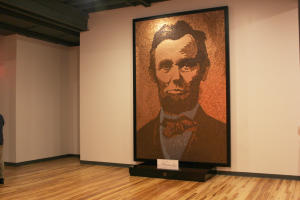 have to think big. That’s what Battle Creek artist Richard Schlatter did in 2017. He used more than a million pennies to create a potrait of Abraham Lincoln that is 12 feet high and 8 feet wide.
The piece won the grand prize at ArtPrize 9 and now resides in a room where community members can gather for meetings, book clubs, or studying.
3. W.K. Kellogg Foundation
The W.K. Kellogg Foundation began with the humble, yet visionary commitments of W.K. Kellogg, who wanted to invest his fortune in the health, happiness and well-being of children. With hometown pride and deep care for the place that 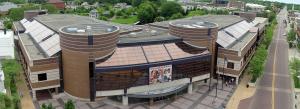 raised him, he started by investing in the children and families of Battle Creek, Michigan.
The foundation grew and is now one of the largest in the world managing over $8.7 billion in assets. The beautiful headquarters location was built in 1990. The grounds behind the building have the Kellogg House and the Underground Railroad Monument.
4. Mill Race Park
A large waterfall fountain shows the history of Battle Creek’s manufacturing power.
People have always built around waterways, and Battle Creek was no different. The merging of two rivers attracted government surveyors. They were working near the water when two Potawatomi natives came to ask for food. The surveyors ran them off and made a note of the encounter by simply writing “Battle Creek” on the map they were making. 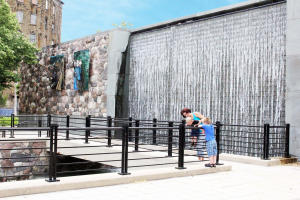
It was speculator Sands McCamly who bought the water rights and paid to build a millrace between the rivers. Like an early version of a generator, the millrace provided power for businesses in the village.
It made Battle Creek a manufacturing powerhouse. The railroad arrived soon after the mill and items were sent out from the city’s factories: agricultural machinery, cigars, cereal, bicycles and more.
5. Military History Mural
This mural depicts local military history, from World War I to the Blackhawks of today. Camp Custer opened up in World War I and expanded into Fort Custer by the time of World War II. Many soldiers have come through Battle Creek for training. While the pentagon building in one of the photos is reminiscent of the big one down in Washington, D.C., it’s actually located at Fort Custer. There’s also the Percy Jones Hospital, which was once Dr. Kellogg’s magnificent Sanitarium. It was an orthopedic hospital 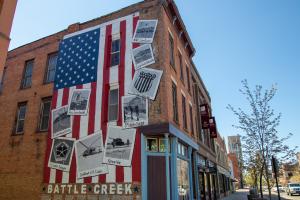 during WWII, and many of the patients had trouble getting around. Battle Creek was the first city to create accessible sidewalks for wheelchairs, so soldiers could do things downtown, like go to the movies. Now the building is the Hart-Doyle-Inouye Federal Center, named after three senators who met at the hospital as patients.
6. First Baptist Church
Organized in 1835, this Baptist organization is the oldest church in Battle Creek. The building you’re standing in front of was first opened in 1871, with additions through the years. The mosaic of Jesus was added in 1959, after the building 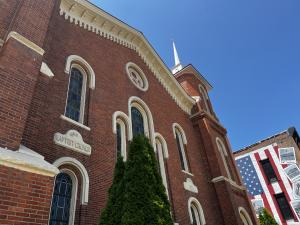 was expanded. If you look up, you should see a steeple that reaches a height of 120 feet. This one was added in 1996 -- the original steeple was hit by lightning in 1899.
7. History Tower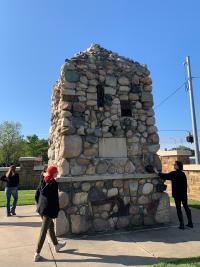
Robert Ripley of Ripley’s Believe It or Not gave a shout-out to Battle Creek’s iconic stone tower, which he called the “Rock of Ages,” according to the Regional History Museum of Battle Creek.
The tower was built by historian James Brown in the 1930s. It’s an odd mish-mash of stones and artifacts. If you stop by, see if you can find: a helmet, an anvil, a letter box, a stalactite, a plate from a printing press and a plaque made from the wreckage of the USS MAINE.
James Brown is also known for coordinating the first motor tours, which allowed people to travel in groups with a tour guide, a lot like today’s bus tours.
8. Sojourner Truth Monument
Sojourner Truth escaped slavery, took on the system to rescue her family and helped African Americans transition into a post-Civil War world. She moved to Battle Creek in 1857, first in the Spiritualist settlement called Harmonia and then to a 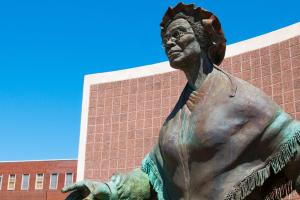 house on College Street. When she wasn’t touring the country, this is where she spent her time, sitting on a porch rocking chair, smoking a pipe and talking to visitors.
We have honored Truth’s memory with a monument, built right where most people enter the city’s downtown. The sculpture is 12 feet high and behind her are quotes. Truth is depicted at a lectern because she used her gift for public speaking to fight for abolition and suffrage. She is buried at Oak Hill Cemetery.
9. City Hall
Constructed in 1914, the neoclassical revival building was designed by E.W. Arnold. It has glass windows, cherry wood, marble decorations and hidden staircases – a grand building, meant to empow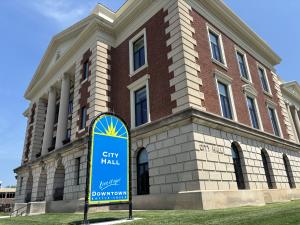 er its citizens. According to the Historical Society of Battle Creek, “It expressed the optimism of Battle Creek and the nation’s pre-war industrial boom, and, as such, can be seen as a symbol of the spirit of the time.”
10. Commerce Pointe
Famous architect Albert Khan designed the building to be a post office in 1904, but it took a while before the city could start using it. By 1907, a headline in the Battle Creek Morning Enquirer said “Post Office Delay Something Fierce.” 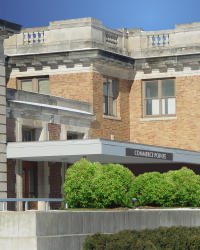 Material difficulties meant the project was held up for years, to the frustration of many.
Once the elaborate Beaux Arts building was finished, horse-drawn carts would pull up to deliver the mail. In 1968, the post office moved out and the court system moved in, changing the name to the Hall of Justice. After a new justice building was built down the street, the old post office became Commerce Pointe
11. Underground Railroad Monument
Battle Creek was an important waystation on the Underground Railroad. This monument to the men and women who risked their lives for freedom is an impressive piece of artwork, at 28 feet long and 14 feet high. The bronze is shiny where countless hands have touched it. 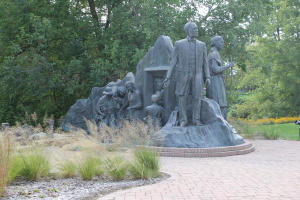
One side depicts Quaker stationmasters Sarah and Erastus Hussey helping African Americans who escaped slavery. The other side depicts Harriet Tubman leading people up North. Tubman actually never stopped in Battle Creek, but her ferocious spirit and contribution to freedom have been honored.
12. Kellogg House
Will Keith Kellogg lived here – well, not here exactly. In order to preserve the house, the Kellogg Foundation had it moved from its original spot. Now it’s used for nonprofit functions. Unless you’re hosting an event, you’re not going to see inside. But feel free to walk around the
well-maintained gardens and admire the prairie-style architecture. 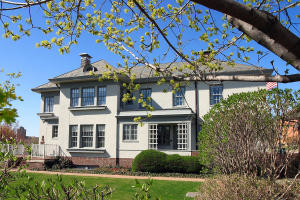
Brothers W.K. Kellogg and Dr. J.H. Kellogg invented cereal flakes while experimenting with creating healthy, easy to digest food for the patients at the world-famous Sanitarium. Will went on to create the Kellogg Company, while Dr. Kellogg ran the Sanitarium.
13. Willard Library
In 1875, Henry Denman bequeathed $10,000 to purchase books for a library. It’s thanks to him that Battle Creek has such a large collection of books, but you won’t find his name on any buildings. An article in 1912 said “At the time of Mr. Denman’s gift, there were only two or three public libraries in the state. He himself was not a wealthy man, but when he died he left 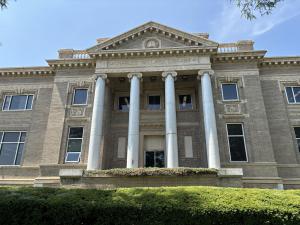 a large part of his fortune to the school district. Heirs contested the will, and a compromise was reached whereby the district accepted $10,000 although his plan before his death was to leave a larger sum than this.”
The library was originally located at the high school, but the growing collection needed a new home. Charles Willard donated money for a new building in 1905. The original Neo-Classical building has four granite columns, facing Capital Avenue. There have been two additions since then, as the library has become an important center for the community.
14. Clara’s on the River
Built in 1888 (Corn Flakes weren’t invented until 1894), this former train station saw the arrival of patients at the Battle Creek Sanitarium and soldiers heading out to Camp Custer and traveling locals with their trunks and suitcases. 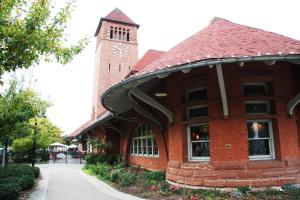
The train tracks have moved, but many people still remember Clara’s on the River as the old train station. It is now a restaurant that features Battle Creek memorabilia in every room. The distinctive red color comes from Lake Superior sandstone. The clock tower has been restored to look exactly like it did 100 years ago.
 15. Linear Trail
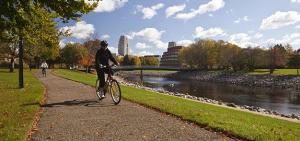
This trail stretches for 26 miles through Battle Creek, which has made it an important connector for the North Country Trail and Iron Belle Trail.
16. Hart-Dole-Inouye Federal Center
This Sanitarium building opened in 1903, after the previous building burned down. It was a modern marvel at the time. 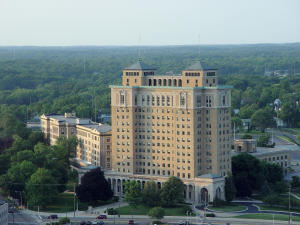
Dr. J.H. Kellogg was praised for his hospital design, which included a system to keep the air fresh through circulation, a surgery, a hydrotherapy annex, gymnasium and indoor palm garden. People came from all over the world to get treatments and learn how to take better care of their health. Many of the Sanitarium tenets we still follow today: eat healthy, exercise, sleep well, relax.
After 1929, Dr. Kellogg was no longer leading the Sanitarium and services were moved to a smaller location. The building was used as a military hospital during World War II, and eventually became the Hart-Dole-Inouye Federal Center.
To see inside the Federal Center, contact Historic Adventist Village. Tours must be arranged a couple weeks ahead of time for clearance.